
Automation Over Abrasion: Why Vibratory Deburring Is Leading Complex Component Finishing
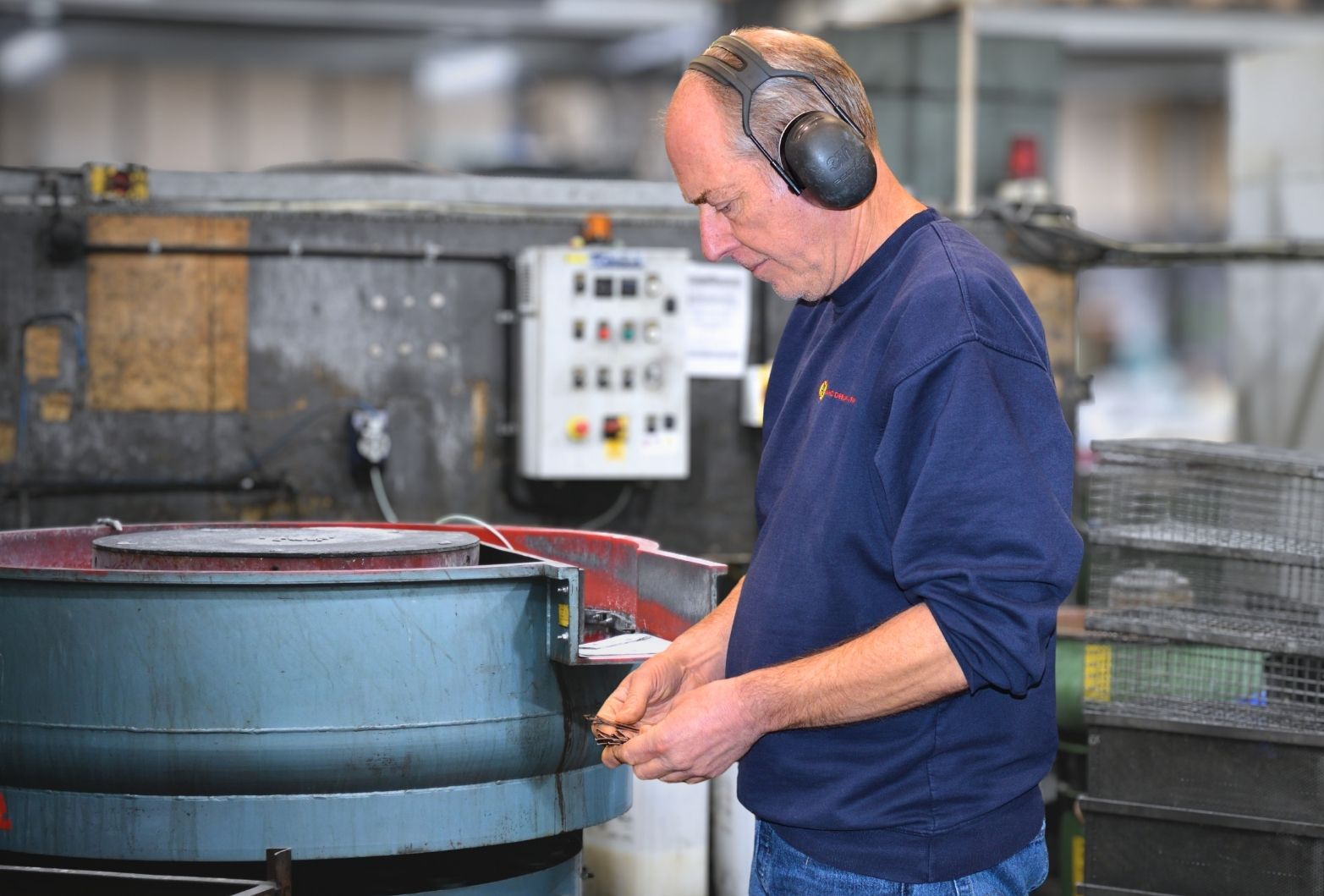
In machine shops across the UK, deburring remains one of the most time-consuming — and often underestimated — stages of the manufacturing process.
Chamfer mills, rotary scraper blades, Scotch-Brite pads and grinding wheels have long been the default solution. Skilled operators can remove burrs from holes, edges and machined features with impressive dexterity. But manual deburring comes at a cost: lost machine uptime, inconsistent finishes, health and safety risks — and in some cases, scrapped parts.
For complex components in aerospace, automotive and defence supply chains, those costs quickly multiply. At Midland Deburr & Finish in Lye, Managing Director Chris Arrowsmith believes vibratory deburring offers a smarter, safer and more scalable alternative.
The Hidden Cost of Manual Deburring
- Manual deburring might appear flexible, but it introduces several operational challenges:
- Machine downtime while operators step away to hand-finish parts
- Inconsistent edge quality, especially on cross-holes and complex geometries
- Risk of over-grinding, leading to dimensional damage
- Repetitive strain injuries and airborne abrasive exposure
- Higher labour cost for low-value, repetitive tasks
“You don’t want highly skilled machinists spending valuable time scraping edges or polishing cross-holes,” says Arrowsmith. “Their expertise should be focused on programming and production — not on laborious finishing.”
In high-value sectors, a heavy hand with a grinder can destroy hours of machining in seconds. On thin-walled or intricate components, manual intervention increases the risk of distortion or rounding critical features.
- Vibratory Deburring: Controlled, Repeatable, Scalable
- Vibratory deburring replaces hand tools with controlled, process-driven finishing.
Components are placed into vibratory bowls or tubs containing specialist media designed to:
- Remove burrs consistently across all edges
- Smooth internal and external features simultaneously
- Access hard-to-reach geometries
- Deliver uniform surface finishes across batches
Unlike hand methods, vibratory processes treat the entire component in one operation — reducing the chance of missed features or uneven edges.
“For complex parts with multiple holes, pockets and intersecting features, vibratory finishing ensures everything is addressed in a single cycle,” Arrowsmith explains. “It removes variability from the equation.”
Protecting High-Value Components
Traditional deburring methods can be destructive when applied aggressively. Excessive pressure on a grinding wheel or blade may compromise tolerances or remove more material than intended.
Vibratory deburring, by contrast, is carefully calibrated through:
- Media selection
- Compound chemistry
- Cycle time control
- Process validation
This allows Midland Deburr to deliver burr-free parts without compromising dimensional integrity — a critical factor for aerospace and automotive customers.
Improving Health, Safety and Productivity
- Manual deburring exposes operators to:
- Sharp edges
- Abrasive grit
- Repetitive movements
- Noise and airborne particulates
By shifting finishing to controlled vibratory systems, manufacturers reduce ergonomic risk while increasing throughput.
“Automation is about using people more effectively. Vibratory deburring improves consistency, protects workers and frees skilled staff for higher-value work.”
A Strategic Advantage for UK Manufacturers
As defence and export markets demand higher volumes with tighter quality standards, scalable finishing solutions are becoming strategically important.
Manual deburring may still have a place for one-off adjustments or precision chamfering, but for production environments — particularly those handling complex machined or stamped components — vibratory deburring offers measurable gains in speed, safety and repeatability.
“In today’s market, finishing needs to be engineered, not improvised,” Arrowsmith concludes. “Vibratory deburring allows manufacturers to eliminate a traditionally slow, risky process and replace it with something controlled, predictable and production-ready.”
Quick Contact Form